
Class E to Residential Change of Use: A Developer’s Pre-Purchase Checklist
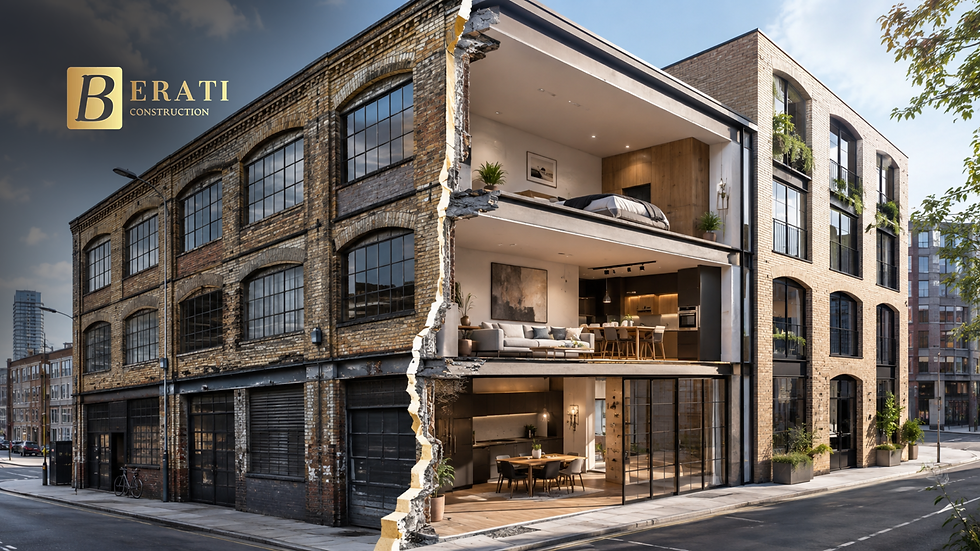
Since the creation of Use Class E, many shops, offices, restaurants, gyms and other commercial uses have been grouped together, making it easier to move between them and, in some cases, to convert to residential. That flexibility has created opportunities, but also a fair number of expensive mistakes.
Use this checklist before you exchange contracts on a commercial building you intend to turn into homes.

1. Confirm the lawful use and planning route
Establish exactly what the building is lawfully used for and whether it falls within Class E. Then ask your planning consultant whether prior approval is available, or whether full planning permission is needed. Prior approval has conditions, such as vacancy periods, size limits and exclusions in some locations, which change over time, so rely on current advice rather than old rules of thumb.
2. Check the physical suitability of the building
Floor-to-ceiling heights, floor plate depth and window positions
Natural light to every habitable room, a frequent problem in deep floor plates
Whether the layout can meet the nationally described space standard
Structure, including lintels, slabs and any previous alterations
Access to upper floors, parking and refuse and cycle storage
3. Commission surveys before you commit
Buy only with a structural survey, asbestos survey, drainage survey and services review in hand. Older commercial buildings often hide asbestos in ceilings and partitions, and inadequate drainage can add serious cost. A fire engineer’s early view on compartmentation and escape is also valuable for multi-unit schemes.
4. Understand neighbouring uses
Noise from adjoining commercial premises, deliveries, extraction systems and late-night activity can affect residential amenity and may form part of the council’s assessment. Sound insulation upgrades add cost, and they should be priced at appraisal stage.
5. Get build costs from a contractor early
Ask a main contractor to review the drawings and walk the building with you. A contractor can flag structural issues, programme risks and likely cost drivers that a purely desktop appraisal will miss. Our guides on converting office buildings and converting shops and pubs go into more detail on those building types.
6. Plan finance and programme
Funders usually want a fixed price contract, a realistic programme and a monitoring surveyor. Build in contingency for unforeseen items and allow time for utilities and Building Control. Our article on de-risking a development scheme covers contingency and cash flow in more depth.
Frequently asked questions
What is Class E?
It is a broad commercial, business and service use class in England covering shops, offices, restaurants, gyms and similar uses.
Does Class E guarantee I can convert to flats?
No. Conversion to residential typically needs prior approval or planning permission, and each has its own tests.
Why do I need a contractor before buying?
Because physical constraints and build costs affect viability. Early advice can prevent an overpayment.
Does Berati carry out commercial-to-residential conversions?
Yes. We deliver conversions from strip-out and structural alterations through to final finishes.
Talk to Berati Construction
Considering a commercial unit for conversion? Berati Construction Ltd has more than 30 years' experience delivering new builds, conversions and refurbishments as a single-point main contractor. Call us on 020 3488 6466 or visit beraticonstruction.co.uk to discuss your project. Our office is at 12 Cecil Road, London NW10 8UJ.

Comments