
Resin Injection and Ground Stabilisation: Fixing Settlement Without Digging Up the Building

When a building settles, the traditional response is often underpinning: excavating beneath existing foundations and replacing them with deeper concrete. That works, but it is disruptive. For certain ground conditions and building types, resin injection offers a less invasive alternative.
This guide explains what it is, where it is used and how to decide.
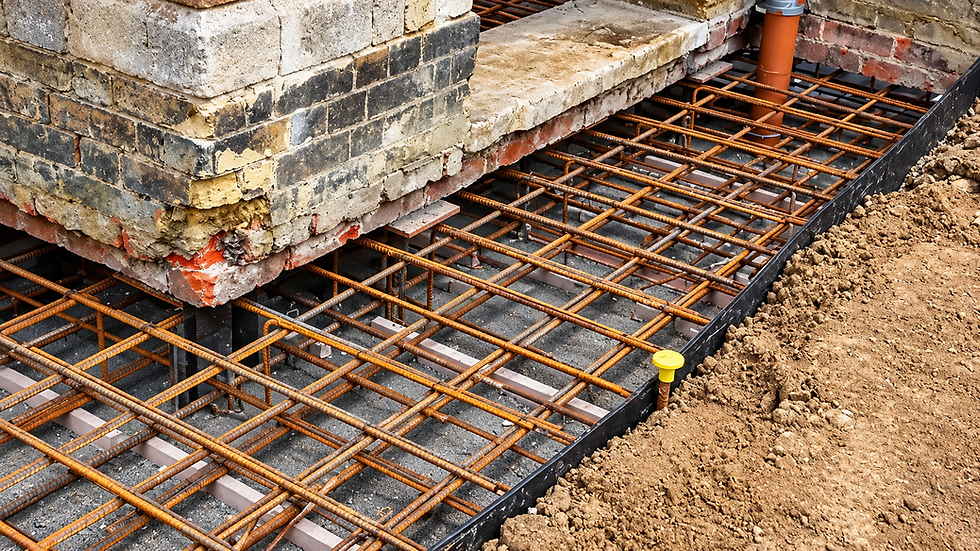
How resin injection works
Expanding structural resin is injected through small holes into the ground beneath foundations or floor slabs. The resin expands, fills voids, compacts loose soil and, where needed, lifts the structure back towards its original level. Injection is monitored with laser levels so movement is controlled precisely.
Equipment is compact, holes are typically small, and the building can often remain in use during the works.
Where it is used
Settled floor slabs and ground-bearing floors
Foundations affected by loose or poorly compacted fill
Voids caused by leaking drains or washed-out soil
Areas where access is too restricted for traditional underpinning
Industrial and commercial floors where downtime must be minimised
When underpinning is the better option
Resin cannot cure every problem. If movement is caused by shrinkable clay affected by trees, or the existing foundation is inadequate, a structural solution such as underpinning, piling or a new foundation design may be needed. Our guide to basement underpinning explains those methods and risks.
The first step is always to establish the cause of movement through a structural engineer’s investigation, drainage survey and, where required, ground investigation and monitoring.
The role of the main contractor
Resin injection is a specialist subcontract trade. A main contractor coordinates it with other works, including drainage repairs, structural alterations and finishes, and ensures monitoring is recorded and results are signed off by the engineer. Read about groundworks and foundations for related ground issues on new builds.
Questions to ask before you proceed
What caused the movement, and has it stopped?
Has a structural engineer specified the method?
What monitoring and verification will be provided?
What guarantee is offered, and who stands behind it?
How does the cost compare with other options?
Frequently asked questions
Is resin injection a permanent fix?
It can be, provided the cause of the movement has been identified and addressed. An engineer’s assessment is essential.
Can I stay in the building during works?
Often yes, because the process is compact and fast, but it depends on the property and the extent of work.
Is resin injection cheaper than underpinning?
Sometimes. Cost depends on depth, area and ground conditions, so get a specification and compare options.
Can Berati coordinate ground stabilisation?
Yes. We coordinate specialist ground treatment alongside structural and finishing works as part of our main contractor service.
Talk to Berati Construction
Dealing with settlement or ground problems? Berati Construction Ltd has more than 30 years' experience delivering new builds, conversions and refurbishments as a single-point main contractor. Call us on 020 3488 6466 or visit beraticonstruction.co.uk to discuss your project. Our office is at 12 Cecil Road, London NW10 8UJ.



Comments